A cloverleaf junction, also known as a cloverleaf interchange or cloverleaf interchange, is a type of complex roadway intersection designed to allow the efficient and safe flow of traffic between two or more major roadways.
Its design resembles a cloverleaf, hence its name, and consists of several ramps and turns that interlock to allow vehicles to make directional changes and merge with the flow of traffic without the need to stop at a traffic light or yield.
At a cloverleaf junction, on- and off-ramps are connected by bridges or overpasses, preventing traffic from crossing directly at the same level. This helps to reduce conflict points and improve traffic flow.
The design of the cloverleaf junction can vary in size and complexity, depending on traffic volume and local conditions. It can also include additional elements, such as acceleration and deceleration lanes, clear signage and traffic control systems to ensure driver safety.
A Junction is composed of several parts
- Main and Secondary Axes
- Inner Internal Branches
- Outer Branches
- Speed Change Lanes
- Crossing
- Structure + Gauge
What is a Branch Line?
In the context of geometric projects or road layout, a spur or chevron is a section of road that deviates or branches off the main roadway to allow access to specific areas, such as communities, industrial zones or tourist destinations.
Branch roads are designed as offshoots of the main roadway and usually have a direct connection to the main roadway via entrance and exit ramps. These ramps allow vehicles to safely access or exit the spur without interfering with the flow of traffic on the main road.
The construction of spurs or gas lines may be necessary to provide access to important areas that would otherwise not be directly reachable from the main road. This may include local communities, industrial parks, commercial centers, or other specific destinations.
When designing a spur or chiffon, several factors are considered, such as expected traffic flow, road safety, distance between the spur and the main road, and proper integration of the spur into the existing road network. Design norms and standards must be followed to ensure safe and efficient operation of the spur.
Main and Secondary Axes
El Eje troncal es de mayor importancia, usualmente es una autopista o carretera de primordial importancia y por tant la velocidad de este usualmente ronda los 110Km/h , mientras que el Troncal Secundario puede no ser parte de la red a disñar y mas bien puede ser una carretera importante que ya existe.
Inner Internal Branches
These are the Axes that have the purpose of making the trajectory shorter, they are the ones that are in direct contact with the structure and are intercommunicated with the Crossing.

Outter Roads
After the leaves or internal branches have already been connected, there are the external branches, also known as channeling gauze, which are usually located on the periphery, are longer and usually have less slope.
What is a crossing?
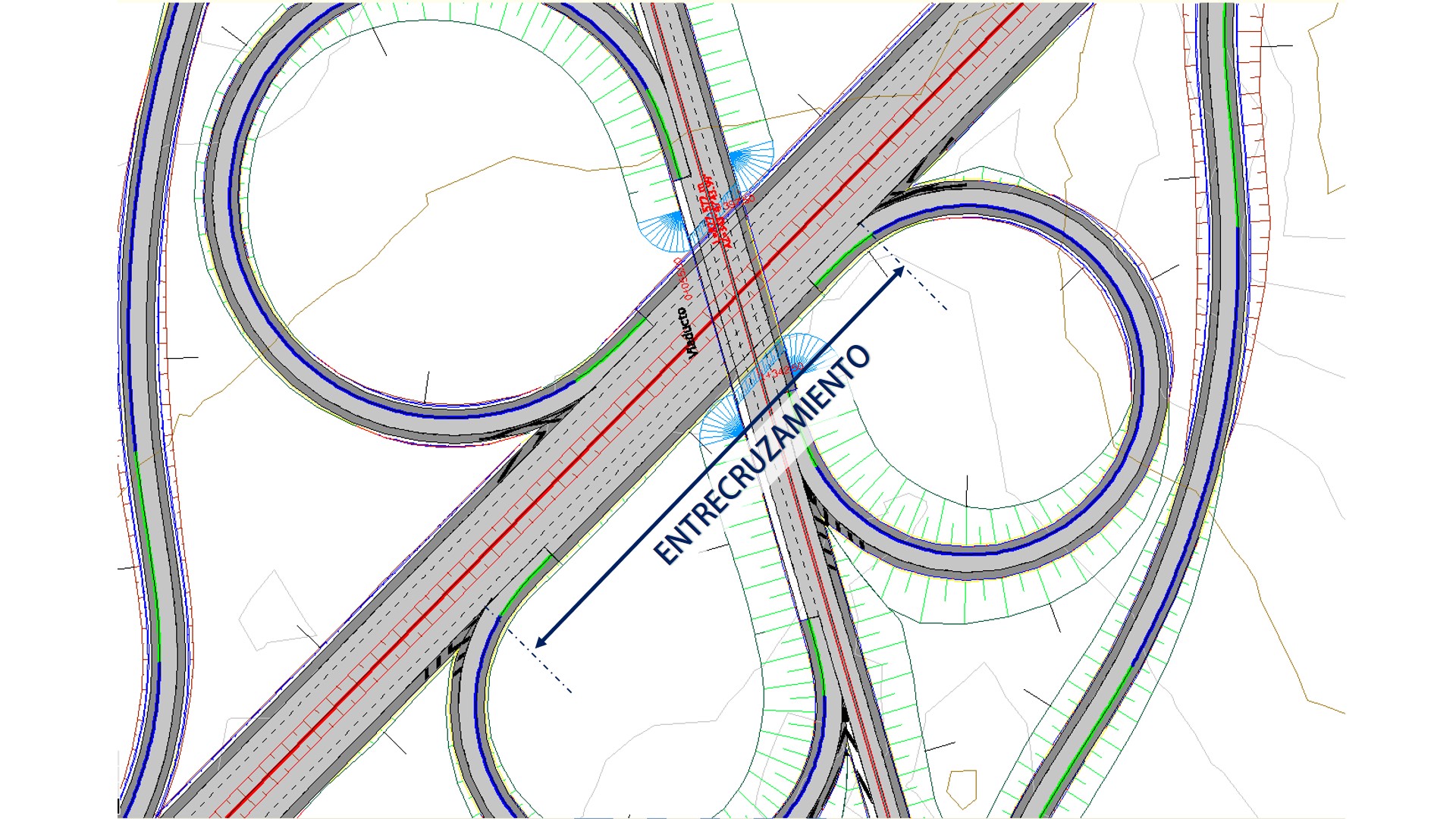
Crossing should be understood as the crossing of traffic streams moving in the same general direction, achieved by successive converging maneuvers, i.e., road sections that share a lane on the same platform, as happens in the intermediate areas of junctions.
What is a Speed Change Lane?
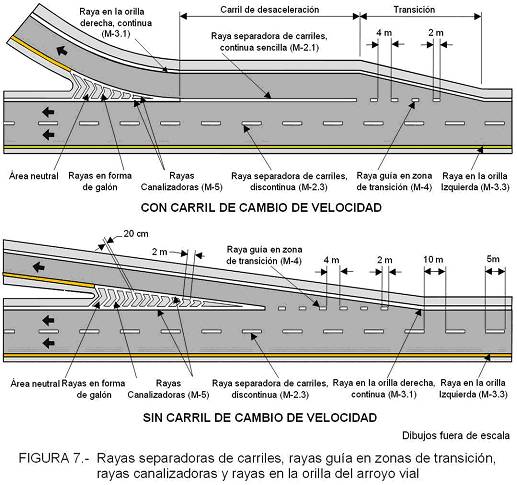
A speed change lane, also known as an acceleration/deceleration lane, is a section of roadway designed to allow drivers to adjust their speed when entering or exiting the main roadway safely and without impeding the flow of traffic.
A speed change lane is generally found on freeway approaches or high-speed roads and consists of an additional section of roadway of sufficient length for vehicles to accelerate or decelerate and merge safely with the main flow of traffic.
When a driver enters the main roadway from an on-ramp, they use the speed change lane to increase their speed to match the existing traffic flow before merging into the main lane. Similarly, when exiting the main roadway onto an exit ramp, drivers use the speed-change lane to gradually reduce their speed and safely leave the main roadway.
Speed change lanes are usually properly signed and marked to guide drivers. In addition, they may have specific length and design requirements to ensure that there is sufficient space for maneuvering and to allow for safe transition between lanes.