
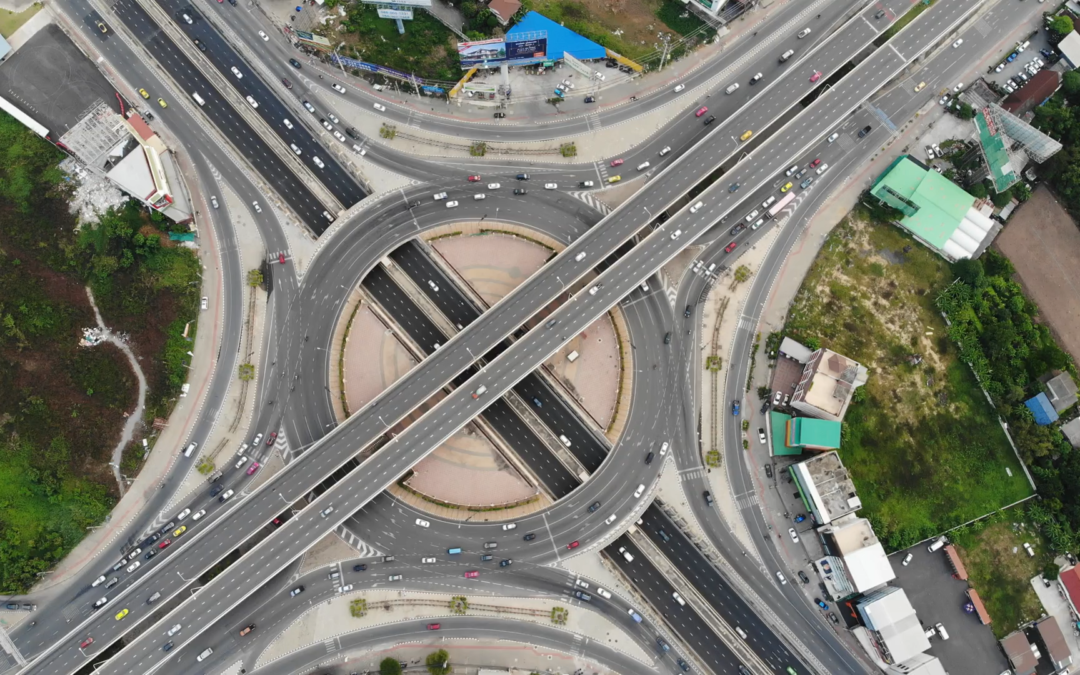
Parametric Design of At-grade Junctions, also known as intersections or road junctions, are meeting points between different transportation routes, such as highways, streets or freeways, which allow vehicles to cross in different directions. These intersections are designed to facilitate traffic flow and improve road safety.
There are several types of road interchanges and all can be easily developed with ISTRAM, each with specific features and functions. Some of the most common are:
1. traffic circles: these are circular interchanges where vehicles must circulate around a central island to take the desired exits. Traffic circles help to reduce traffic speed and improve safety by avoiding at-grade crossings.
2. At-grade intersections: These are common crossings where roads intersect in the same plane. They can be controlled by traffic lights or stop signs, and their design seeks to regulate vehicular and pedestrian flow to avoid conflicts.
3. Overpasses: These interchanges allow roads to cross at different levels, avoiding the interruption of main traffic. Overpasses include bridges, tunnels and viaducts, and are often used in areas with high traffic volumes or where continuity of main roads needs to be maintained.
Road interchanges are important for several reasons:
1. improved traffic flow: By providing efficient connection points between roads, interchanges allow vehicles to move smoothly, reducing travel times and traffic congestion.
2. Road safety: Properly designed interchanges can contribute to accident reduction by minimizing points of conflict between vehicles and pedestrians, and by properly regulating traffic flows.
3. Transportation efficiency: Well-designed road interchanges facilitate the efficient movement of people and goods, improving connectivity and accessibility in transportation networks.
4. Adaptability: Road interchanges are flexible and can be adapted to different traffic conditions and requirements. Their design can be adjusted to accommodate changes in vehicle volumes, incorporate traffic management technologies, and promote sustainable transport modes.
In summary, road interchanges are key elements in the planning and design of road infrastructure. Their proper implementation and maintenance are essential to ensure efficient, safe and smooth movement of vehicles, thus improving the quality of life for road users.
The most complex intersections can be developed with great ease in ISTRAM® thanks to the efficiency and computational power that has been the foundation on which ISTRAM® has been built since its inception.